Saturday, May 19, 2012

Nihal Shawabkeh, Rami Levy markets


Nihal Shawabkeh

Human Geography

Final Paper


Rami Levy markets

Every time I leave my home to my University, I don’t stop just for one second to think or to discuss why this market is here? Or why these borders are here? Something cannot deny, when you go to Aseon near Hebron something will take your attention and make you feel day dreamer which is a big markets put in this place called “Rami Levy Market”.


What you need and what you imagine you will find there, start from food to clothes. But in other hand you will see a high numbers of Arabic people bought from this market because they have many reason to buy from it, but you can’t believe what happened when I stop to see this market in one of the Ramadan’s day.


In this day I went to my grandmother’s house and when I went to walk with my sister in the street and stopped for just two second and saw this location, this is the first time I saw this market and I was surprising what the hill is this? About hundreds person came to Rami Levy Market to buy the products. In this time I put my hands in my head and remembered something, which is in the last month we saw in the television very important event which is boycotting the Israeli products because big part from this money goes to bought guns and many dangerous thing which used to kill the Palestinians people.


I thought and didn’t know what could I do? I take my sister and went to this magic world, in the first step we faced two people in the door and they made a security movement then they allowed to me and to my sister to enter the market. But the magic start when I saw this big shop, all the thin g you need you would find it here start from the small thing to the big one. Oh my god! This amazing place which include all things that organized and all the praises put in the products and all things put in the best place.

However, the most important thing which takes my attention is the high numbers of Arab people who work in this market and in different places. And if you go to the next place you will see the special place to put your car her but this place just for the Israeli people and they avoid any person to be in this place. 

note: These picture are from the internet because they didn't allow me to take picture of this supermarket.


Imad Adwan - Al-Bawaba Both Sides

http://youtu.be/B-T5o826jII (Please Read before watching, to understand better PLEASE watch it on 480p) Imad Adwan Professor Alessandro Petti, Human Geograpy - Final Project Al-Bawaba Alma'bar is starting point, where I started my trip going to the other side of AlBawaba (the gate) where I used to live before building the separation wall that was build from the the inhabitant of my neighborhood to be part of Jerusalem not part of the West Bank (Bethany) they built the wall from their own money, after winning the court against the Israel, optinal to pay the money themselves to built their own wall, and it was special wall where its yellow and a higher one other than the concrete wall of the Isreali Army. I go to the other side of the Bawaba, showing both trips in the same time and both side of the Bawaba. The West Bank side is located on the left side while on the right side is located Jerusalem side. Starting at the same time both trip at the same point showing that both trips reached to the Bawaba on the same time the both side of it. It took the trip 6 mints to reach Albawaba, so the total trip if I want to go just to the same exact point next (on the otherside of the wall) the time used to to take few seconds and after building the wall its took 15 mints to get their without counting the time to cross the Ma'bar of Jerusalem (usually takes 20 minutes without people jam) on Bethany side (the starting point) knowing that I can't enter Jerusalem without permition.

Tuesday, May 1, 2012

Ahmed Hmeedat, Art of being lost

click on this ink to see my short film.

        Many people get lost during their ravel from a certain place to another,. Some of them get confused don't know what they have to do. but the common way to figure out the way is by asking people for the right way. that what the movie tells us by appearing me as a lost person asking people for the righ map to arrive Al-Quds University from Dehiesha cmap. Art of being lost shows us how can one arrive to his wanted place inside the West Bank by asking strangers.   


Bethany a dead city behind the seperation wall - ruba imam


Ruba Imam

Prof.Alessandro Petti

Human Geography

AL-Eazar (Bethany)

This project examines the effects of the seperation wall on tourism in Bethany, as well as its effects on the social and economic aspects of the city. It tries to show these effects through comparing the situation beore and after building the wall, supporting the claims and examination with numbers that prove the dramastic changes that took place. Collecting information was based on interviewing souvenir shop owners whose shops are located in the area behind the wall and who are part of the citizens that have been affected by the wall.
Bethany, or in Arabic called "Al Ezaryah" is a small town to the east of Jerusalem. Bethany used to be part of east Jerusalem until the separation wall was built. It used to be a conjunction point between West Bank and Jerusalem. If one passes through the main road of Bethany, s/he can see a number of churches on the way; that's because of the religious history of the town where Jesus brought life back to a man called " Al Eazar". It is believed that Al Eazar is one of God's messengers and so the town was named after him. Visiting Palestine, Bethany is an important stop for tourists coming to Jerusalem. Before building the separation wall Bethany used to be the second stop for tourists after Jerusalem. It was easy to reach regarding the fact that it is one of the nearest towns to Jerusalem. In fact, Bethany has its own special standing; it is the first stage of the Via Dolorosa, meaning that it is the starting point of the sufferings of Jesus Christ. Despite this strategic importance, Bethany today became the last stop for tourists in Jerusalem. This has affected tourism in Bethany in many ways.

After building the wall many changes happened to the town. Not only the objects and movement of people changed but also the change included people's lives, whether inside or outside Jerusalem. These were the words of an owner of a souvenir shop in Bethany. His shop, as well as other souvenir shops, are located precisely behind the wall where a church stands. The wall created distance between tourists and the places they need to visit in Palestine. From this point, Bethany became a less interesting place for tourists after the wall. It became only a past without any present manifestations or signs of life. The ability to visit Bethany became less possible; souvenir shop owners made this point clear when they stated to me that the percentage of tourists has become less by 70% after building the wall and barriers. In fact, the wall is not the only effective factor; the political situation also has its own role. One of the souvenir shop owners gave precise numbers for this decrease in the number of tourists. He stated that before the Second Intifada, 10,000 tourists used to come to Bethany during certain holy occasions. As for the present time, less than thousand tourist visit during these occasions. Moreover, in the period of 2000 until 2006 souvenir shops were closed as a result of having the political situations affecting the tourism sector in Palestine generally and in Bethany and Jerusalem specifically.    

            This shows how the wall and political reasons affected the lives of people and tourism. First, some souvenir shop owners had to change their profession due to the economic deterioration. And second, holy places situated behind the wall ( like Bethany) became less reachable by tourists. As a result, Bethany's religious significance became something from the past. The Past that has become buried in the remains of the old houses of the city, and its glories has become imprisoned behind the grey separation wall no matter how much people try to keep it in their minds. For these shop owners I felt that going back to the lost past and living in the glory of the old days became nothing but a dream.
Pictures from the tourist site in the city that also show part of the seperation wall in some of the pictures below:


Tuesday, April 24, 2012

Mae Shuaib, Ein Yabrud:Euphoria a piece of heaven on earth

Mae Shuaib:


http://www.youtube.com/watch?v=Tm_qU4IGBYo


(Intro)

Ein Yabrud a village near Ramallah is interesting for all ages, particularly for an adventurous trip in the valley. Its small and everyone knows everyone. My project will discuss the old areas of the village, not only their significance but their historical relevance for the people. The valley of old houses in Ein Yabrud called Shahoun still exists until today. I don’t live in it or have family living in it but I pass it every day on my way home. My view on the ride home includes Shahoun in the forefront, then Ein Yabrud, then the Ofra settlements in the distance. Beer abo Khasaba is a place for land, cultivating, barbecues and the well people get water until today still. I go there sometimes for fun. It's open, beautiful, vast landscape.

I never pictured my village to be open and vast because I always thought it was a straight two way street village with a couple of stores. My grandfather told me his experience in the village. Just the short area I have chosen to video is beautiful. Its interesting how these certain places still exist/stand, especially the Wade el Kuleya, which is the cave that takes you to Yabrud, where people used to hide from the Israeli soldiers in the past. Beer abo Khasaba still stands today and people go get water there but it is a village no one knows or passes by. People used to live in Beer abo Khasaba only for vacation, during summer time. During the winter people would go back to their homes to sleep because Beer abo Khasaba is an open space. No water in village so they go back to Beer abo Khasaba. Cooking was done in the cave. Many types of vegetables, fruits and trees were produced in the land of Beer abo Khasaba. Since the Ofra settlements established people are not allowed to sleep in Beer abo Khasaba like before. 

This video project will show the significance of one small village, and how the monuments and landscape are useable and pretty. Using my grandfather as an example shows the relationship the teenagers and elders, and how we both use the same space.

Wednesday, April 11, 2012

Atlas of senses demonstrate observing our senses on the way from Ramallah to Abu dis with a timed map on each point, and I intent to develop my work with a video titled with the different senses we use like the smells we smell on the way, the sound and what I hear along the ride.

Time - 8:30

In the Mujamma3-
Sounds: taxis beeping, taxi drivers shouting for their destination
Smell: Coffee, fuels, smoke

From the Mujamma3- Al manara square
Sounds: guy selling tea, cars, little kid crying, Fairouz on the radio
Smell: Fresh bread, toasted coffee beans,
taste: xl
sight: cars, passengers, lions on the manara, lines on the atm machine

Qalandia
Sounds: annoying music from the radio, a girl on the phone, taxi driver talking to the guy next to him
Smell:  old books, girls perfume, sewage, dust
Taste: none
Sight: traffic, graffiti on the separation wall, guys from the camp trying to organize the road, trash on the road, rocks and burning buildings from a previous demonstration

Qalandia- Jaba3

Sight: guy selling vegetables, a small car selling tea and coffee, broken cars, dead dogs, Jaba3 checkpoint, israeli soldiers

Touch: seat belt

Jaba3- Hizma

Smell: dust, sweat
Sight: check point in Hizma, separation wall, yellow plate cars in traffic
Sound: disturbing radio presenter with a weird squeaky voice

Jericho st-
Sight: beautiful nature
Smell: smell of a hot breeze, car exhaust
Sound: people exhaling

Ezariye- university
Sight: settlements, a piece of Jerusalem
Sound: coins to pay for the taxi
Smell: sewage, animals


Imad Adwan


My Neighborhood’s Map

            Israel has been building settlements; walls; trenches; checkpoints; electrified and razor wires, and also military roads, as part of its policy to control after the occupied to the Palestinian territories 1967, under what known now as the 'Matrix of Control' to keep the 'security' of Israel, as Wendy Pullan said, "Israel has imposed an increasingly violent and oppressive occupation for nearly 40 years, it is particularly the Palestinians who suffer from what can called an 'asymmetrical' conflict, and are subject to imposed shifts in their own geography that are often incomprehensible and badly damaging to their well-being." She continued, "Israeli territory is also geo-politicized so that aspects of Israeli civilian life are eclipsed by security restrictions, and by the population's own fears and distrust." (261, Contested Spaces) Dr. Michael Ryce defined Violence when as he said, "Violence is an attempt to control. The more insecure or out of control people feel, the more violent will be their thoughts, words and actions." (Page 2, Why is This Happening to Me Again…) The violence which has took a place in the political plan of the matrix of control on the Palestinians both Muslims and Christian. Living as a Palestinian and facing the occupation's Policies towards the West Bank and Jerusalem; also living towards my town, and my neighborhood in particular, which is located between Jerusalem and the West bank, affected and changed my way of looking at things in my neighborhood, and changed my point of view about living in the prison of the Jerusalem-West Bank, and Jerusalem-Bethany at the same time.
I usually walk into my neighborhood peacefully thinking of the wall which was built to separate the town from Jerusalem. In this paper I am trying to show the details of my neighborhood where I live in a town called Bethany or Lazarus the historical name for the town.
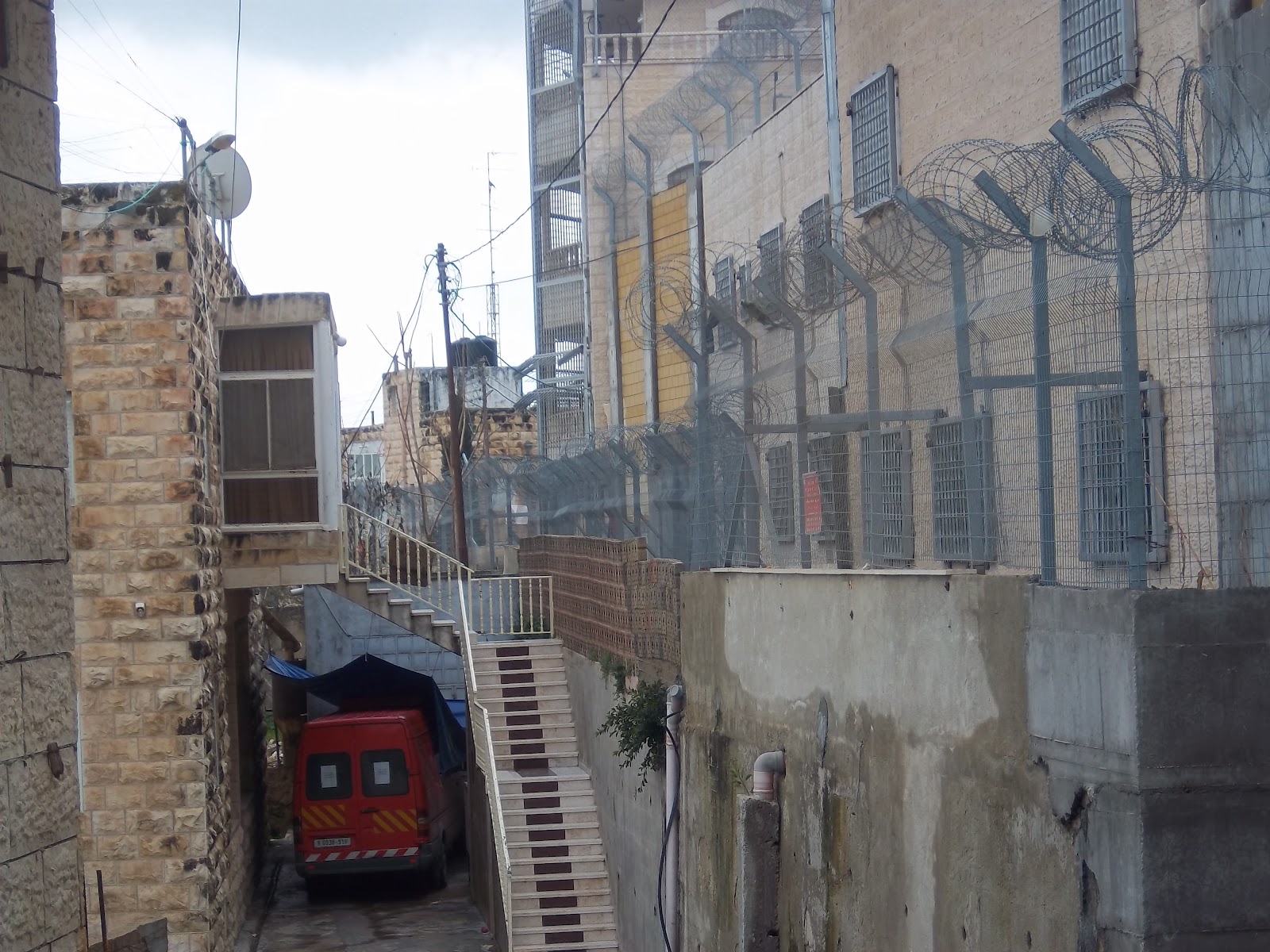
Bethany which is two kilometers away to the East of Jerusalem. My neighborhood which is located now in area used to be known as Albawaba, which means the Gate; although it was not actually a gate, it was just a path to Jerusalem controlled by the Israeli army. It was the main Path for the West Banker of Bethany inhabitants to reach their jobs, schools, or even hospitals in Jerusalem. After starting building the Separation Wall in 2002 what made Bethany surrounded by a wall of apartheid from three sides the Western and Eastern, Southern and today the town's people live in a big prison.
The plan was not only to divide our neighborhood, or dividing my town, its major plan for the whole area, so after dividing Palestine and made it up of two parts, West Bank and Gaza Strip, the plan was to divide the West Back and divide the cities of it.
A house that now part of the wall itself where its residents live in their house that part of the apartheid wall where the house balcony is stretched among the wall and the barbed wire there are many reasons why my father choose that Bethany, and that neighborhood exactly to live in. But the main reason simply can be referred to Allan Jacobs and his book looking at Cities where he started his argument in the first chapter when he said, "You can tell a lot about a city by looking."  My father simply looked at the area, and it was the best decision to take at that time; a West Banker live ten minutes away from Jerusalem by car. Where his job, his children schools and his life city center the only place where he is in Jerusalem and West Bank at the same time.
Albawaba was the gate to Jerusalem for many years till they established Alzayton checkpoint. Students and teachers going to their schools, doctors or patients heading to the main hospital for the Palestinians in the West Bank Almakased hospital, and also the old ladies with the big bags upon their heads, filling with anything they produce or buy, to sell them in Jerusalem streets, all kinds of people used to come through Albawaba to reach Jerusalem.
Every Morning I wake up to start my day like I'm going out of a prison, by walking next to a huge wall was built by the Israelis just next to our house. And see the same view of the real occupation image, where the first thing I see when I look through my window or get out of my house is the huge wall and the control tower. A scary gray concrete tower with colored patches of paint, from the angry Palestinian opponents of the apartheid wall. The tower was built in the form of cylindrical on the top of it there are windows that allow to the soldier inside to see when nobody outside the tower can see if there is someone inside looking or not so all the time people act like there is always someone inside watching them, and their movements. For me too I don’t feel comfortable when I stand in front of the window in my room, where the curtains are usually closed, and if I was taking his path out of the neighborhood in front of the tower I walk fast. Next to that tower, there is a huge gate that can allow for a big tank to go though it easily.
While walking in the streets of that small neighborhood there are many things can't be seen anywhere else in the world, no such humiliating treatment for the people. One side of the neighborhood you see the mosque of Lazarus and the church of St. Lazarus are hugging each other. And on the other side, the one can see the hooligan activities of the Israelis toward the religious places to both Muslims and Christians of confiscating some of the lands of monastery of AlbasionstAnd the monastery of Alfrcescan (Der Biet Faga) was made as a prison by surrounding it of the wall and cutting the Historic monuments in Bethany from each others and divided the whole area.
The cemetery of Bethany is in our neighborhood there, where I see it everyday, and see the part of death, in this life. Some of the graves were destroyed to complete building the humiliating wall. Many other images you can see in my neighborhood, like the green ID inhabitant that living inside what's now known as Jerusalem and before a year it used to be part of our neighborhood in the West Bank. Our neighbor's life all in Bethany, the place where he and his family decided to live but the plan of construction of the wall put them in the other side of the wall where they are now in Bethany and Jerusalem at the same time, their names are written in that gate, and that’s the only place they can enter their houses if they were in the West Bank, and it's a very difficult process to have guests in their house because they need to have permit to get into that small gate that lead to a whole world behind it.
There is. And the same morning at the same time the soldiers open the gate twice for the children of Kindergarten in the other side of the wall. One time it opens about eight O'clock in the morning, and another time at one in the afternoon. The wall didn’t even have a mercy for the small children that go to the kindergarten where the apartheid wall is part of the kindergarten construction.